
Kyiv, 26 August 2026
On 10 May 2026, following notification from NABU of possible violations by certain Company employees, the Supervisory Board directed the Management Board to conduct an internal investigation and suspend the individuals concerned for the duration of the review. The Management Board issued the internal investigation order and suspended Mr. Dmytro Ilchuk the next day.
On 24 August 2026, the Holosiivskyi District Court of Kyiv issued a judgment in case No. 752/16235/26, granting nearly all claims brought by Mr. Dmytro Ilchuk. The court invalidated the Supervisory Board's decision, cancelled the related internal investigation and suspension orders, ordered Mr. Ilchuk's immediate reinstatement, and awarded average earnings, moral damages and court costs.
Energoatom will appeal the judgment within the statutory period and procedure. The Company is also reviewing the procedural circumstances of the case and will consider referring any identified judicial conduct concerns to the competent authorities.
Why the Supervisory Board Is Raising This Publicly
The Supervisory Board fully respects the right of every Energoatom employee to challenge Company decisions before an independent court. Effective corporate governance requires both accountable decision-making by companies and fair, independent judicial review of those decisions.
At the same time, the Board has a responsibility to speak when the circumstances of a proceeding raise serious questions about procedural fairness and the Company's ability to discharge its governance and anti-corruption responsibilities.
Mr. Ilchuk was suspended while an internal investigation examined matters referred to by NABU and a whistleblower. Temporary suspension is a discretionary measure available to the Company — which is of strategic importance to Ukraine's economy and security — for the duration of such an investigation. It is intended to protect the integrity of the fact-finding process and was never intended as a finding of wrongdoing.
The circumstances surrounding the subsequent court proceedings raise serious concerns:
● Late recusal and reassignment. The judge originally assigned to the case had been personally acquainted with the claimant since their time studying together at university — a fact the judge did not disclose to the Company. The claimant sought the judge's recusal on 20 August (approximately two months after proceedings began), although the acquaintance was known to him from the outset. The recusal was granted that same day, and the case was reassigned to a new judge, who received the case materials on 24 August.
● Energoatom's request for a hearing was not addressed. Over the course of the proceedings, the claimant's evidentiary request was granted while Company motions remained unresolved. Energoatom's request for a hearing with the parties summoned, an important step given the value of the claim, was neither addressed nor mentioned in the court's rulings. Separately, neither judge ever ruled on Mr. Ilchuk's 21 July application to amend the subject matter of his claim, leaving the Company with no procedural opportunity to object to that application, which sought his reinstatement to a position he had never held, in a department in which he had never worked.
● The merits were decided within minutes of the case being accepted. On 24 August, the newly assigned judge issued a ruling accepting the case into his proceedings and rejected the Company's request to transfer the matter to general proceedings. In doing so, he did not address the Company's motion to dismiss the Supervisory Board as a party to the case, nor its request for a hearing with the parties summoned, and - most notably - did not accept for consideration Mr. Ilchuk's application to amend the subject matter of his claim. Only five minutes later, that same day, the judge issued a 15-page judgment on the merits – all within a single day and without an oral hearing. The judgment nonetheless appears to take into account the substance of that amended claim - reinstatement to a position and department Mr. Ilchuk had never held or worked in – even though the amendment itself had never been formally accepted for consideration by either judge.
Taken together, these circumstances raise serious questions about whether Energoatom received the fair and procedurally regular consideration to which every litigant is entitled. Those questions should be examined through the appropriate appellate and judicial accountability mechanisms.
Why This Matters Beyond This Case
Energoatom operates critical national infrastructure and provides approximately half of Ukraine's electricity at a time of war.
The Supervisory Board is undertaking a significant programme of governance reform, including the selection of new leadership, establishment of strengthened independent control functions and an external assessment of the Company's governance and controls.
For those reforms to succeed, the Company must be able to respond responsibly when law-enforcement authorities raise concerns about its employees. An internal investigation exists precisely to establish facts. A temporary suspension during such an investigation does not presume guilt; it can be an important safeguard protecting both the investigation and the institution.
If strategically important state-owned enterprises cannot take reasonable, lawful and proportionate interim measures in response to information from anti-corruption authorities without facing substantial liability, the consequences extend beyond Energoatom. It could weaken the practical ability of state-owned enterprises' supervisory boards and management to respond promptly to corruption risks.
“This is exactly the kind of case that should concern anyone who wants Energoatom's governance reforms to succeed,” said Rumina Velshi, Chair of the Supervisory Board. “We fully respect the right of every employee to a fair hearing before an independent court. Our concern is with the extraordinary procedural circumstances surrounding this decision and whether Energoatom received the independent and procedurally fair consideration to which every litigant is entitled.”
Energoatom Supervisory Board Raises Serious Concerns Following Court Ruling on the Suspension of an Employee Linked to a NABU Referral
More news
Company news
Greetings from Rumina Velshi, Chair of the Supervisory Board of JSC “NNEGC “Energoatom”, on the Company’s 30th Anniversary
17 October 2026
Company news
Energoatom’s Supervisory Board submits the Interim Report on the Corporate Governance assessment to the Government
16 October 2026
Company news
Pavlo Pavlyshyn Assumes Role as Energoatom Chief Nuclear Officer, Strengthening Nuclear Safety Leadership and Operational Resilience
16 October 2026
Company news
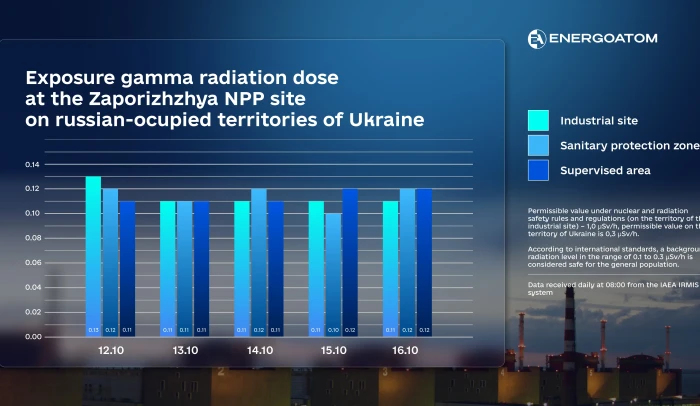
Radiation status at Zaporizhzhia NPP from October 12 to October 16, 2026 – within current standards
16 October 2026



-
About us

-
News
-
Structure
-
Activity
-
Procurement
-
Safety
-
Announcements
-
Information for shareholders and stakeholders
